In the winter of 2015, my wife and I (newlyweds) began outlining our long-term goals and strategy to help identify opportune moments to purchase a house, have children, and other major life occurrences and purchases.
In my current occupation, I have a fair amount of predictability in pay and overall assignment timeline. Since we had a good amount of predictability, we began to identify a conservative estimate of when we could buy/build our dream home and how much we could spend.
I wanted to establish a rough budget for the entire project and then reverse engineer yearly and monthly savings goals, so we could easily chart our progress towards building this home. Once I had an idea of how much, I began to think ‘how much of what?’
“Why did you decide to build a riad?” you might ask… Well, all throughout my life I have been interested in geometric patterns, interlocking patters, and tessellations. I naturally enjoy patterns and quasi-drafting much more than drawing trees or attempting to draw any animal in motion.
In my early adulthood, I was exposed to Islamic and Early Christian architecture from Southern Spain (Al-Andalus), Morocco, and Persia (Modern Iran). The colorful, complex, and multi-layered designs captured my gaze and spurred my imagination.
My initial inspiration was based on a central courtyard surrounded by archways that mimicked the design of Real Alcalzar and the Bourgeoisie homes in Granada, Sevilla, Cordoba, Fez, and Marrakech. I would be dishonest to say that Dorne from Game of Thrones did not factor into this, but technically those sets also count as Al-Andalus.
Later inspiration came from a two-week trip to Rajistan, India I took with my friend Marcus; specifically, from the tomb of I’timād-ud-Daulah and some of the other fortification work around Agra. One day in 2015, Rachel said that she wanted a house with a courtyard inside, like a riad she had seen on House Hunters International, and all of this clicked. We came to a similar conclusion about wanting to build a house centered around a courtyard. I began to make simple drawings to analyze square footage, and realized this design concept would take some serious consideration and planning.
I developed about 12 different floorplans in 2016 that were all centered around a central courtyard. Each floor plan evolved from its predecessor in terms of space utilization, size, and planning factors. I initially used PowerPoint, as the web programs are not too user friendly and have their own limitations. I tried some basic design software, but there are unwieldy to use and not exactly intuitive. The pictures below represent key points in the initial concept design and are basically adjacency diagrams.
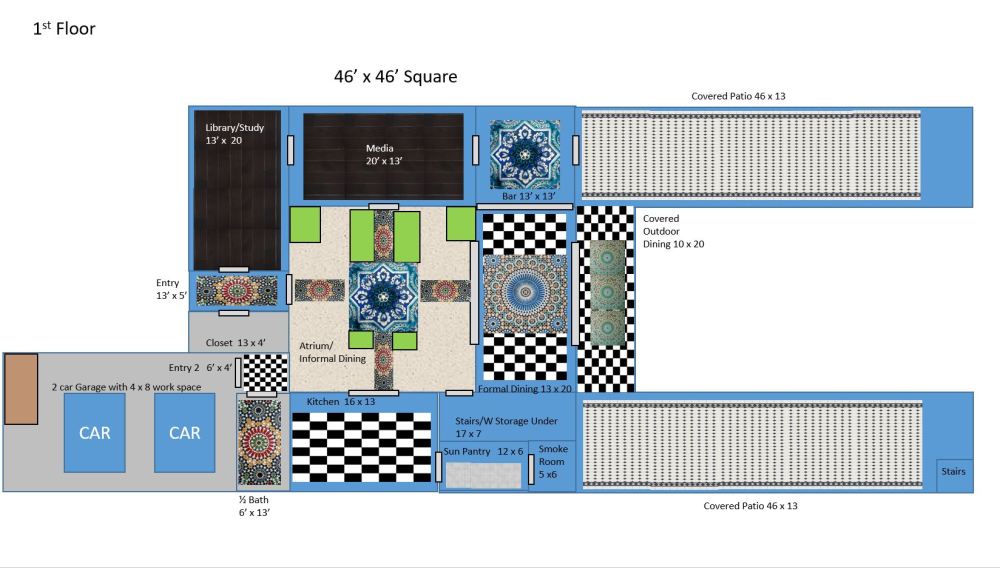
The first design is centered off a courtyard and does not factor covered hallways. Once I finished this design, I began to think about how to enclose the atrium, and what associated structures would be needed.
I will discuss the atrium enclosure in a later post once I receive some quotes back from a vendor – as of now it is possible and costs $80-100 per square foot. The first design also includes large covered patios in the backyard which are not feasible (at least at that size), but still retained in later designs in one form or another.
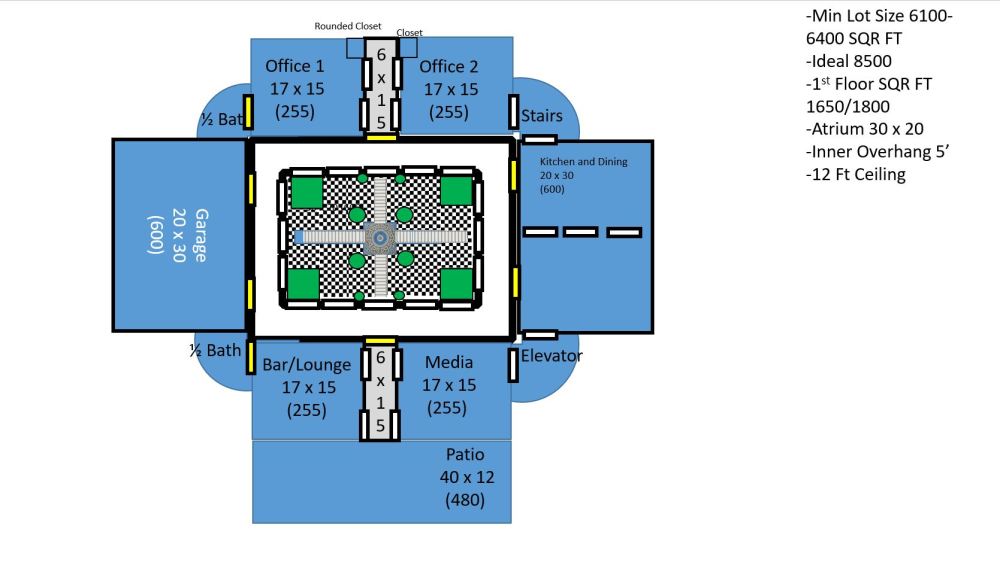
The second drawing now includes the covered walkway and is beginning to address flow between rooms and room purpose. This is the first drawing that included an elevator, which is important, considering that I plan to retire in this home.
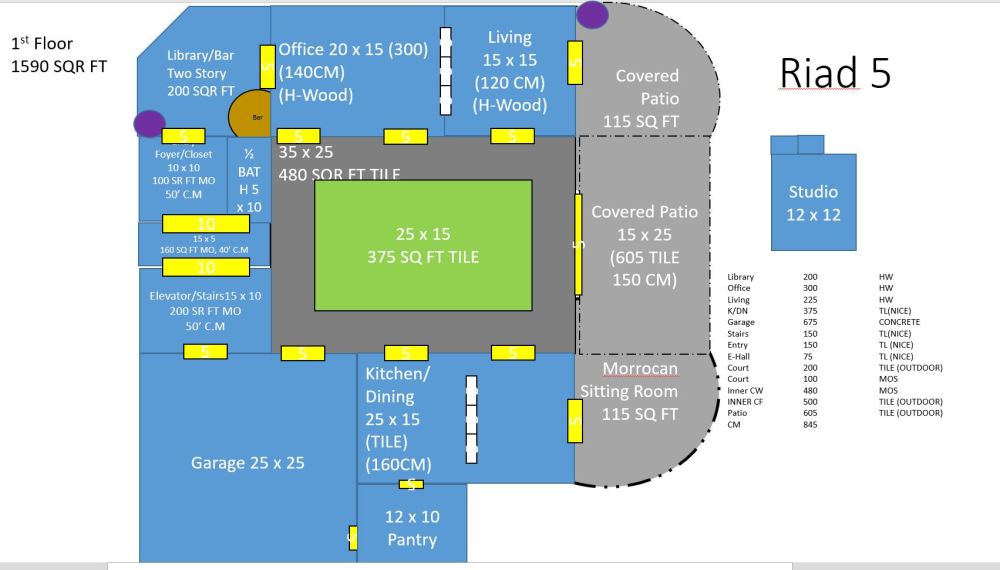
The third design is one of my better ones, but still lacks refinement. This design is the first time I was able to calculate a rough premium cost for all of the tile, trim, elevator, sauna etc. I ended up somewhere around $230K on this estimate.
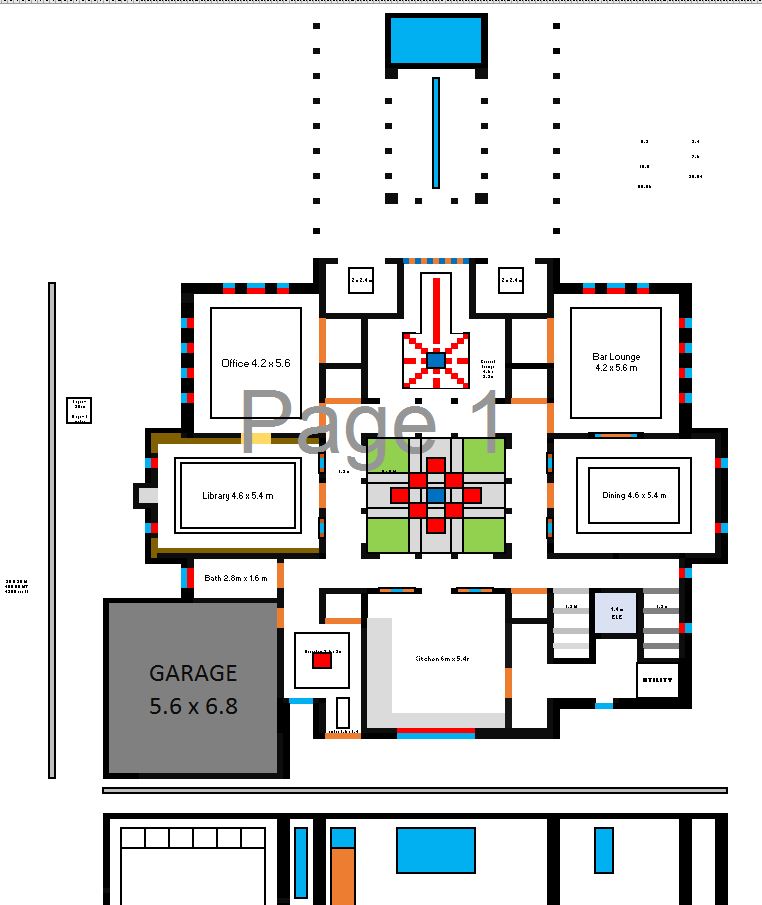
The final design shown here is where I am currently at as of November 1, 2016, and reflects my movement to Excel.
Pro-Tip: When drawing in Excel make sure to even the squares which are scaled differently. This design allows me to better work with calculating costs by building simple calculators. In all designs, I found it is much easier to work in metric, as the base ten system is a wiz for quick math.
The so-what of all this, is that after making a butt-load of designs and building a ton of Pinterest boards, I found out I needed to get a few questions answered before I really begin refine the design and start searching for an architect. These design questions can only be answered by visiting and staying in a similar structure, so I planned a shopping vacation to Fez, Morocco over Thanksgiving 2016 with my wife. I booked a room at Riad Al Bartal for four nights, and planned to tour a few other choice Riads while buying some rugs, lanterns and other swag from the Medina. Once the trip is complete I will provide an overview, pictures, and the method on how I built the budget and planned the trip -hint: Excel. So after months of designing, planning and research, below are my current unanswered questions:
- What are the measurements of a Riad for each room? Based on those measurements, what is the overall geometry of the house and intersections?
- What is the climate/micro environment of the Riad during the day? (This data must be average or somehow reconcile with the environment we will build the house in, back in the US, and most likely in Oklahoma)
- What does the tile ‘feel’ like? Is it too busy visually?
- How does light penetrate the structure from the Atrium?
- What is nighttime like in the Riad? Lighting? Temperature?
- How does sound propagate?
My design process cannot proceed until I answer these questions, at least in regards to floorplans and layouts. The design piece will be explored in my upcoming trip to Southern Spain, which is designed to really analyze the tile work and geometric designs I spoke of earlier- and of course eat tapas and get smashed on great wine.
-Mike
 Project Riad